
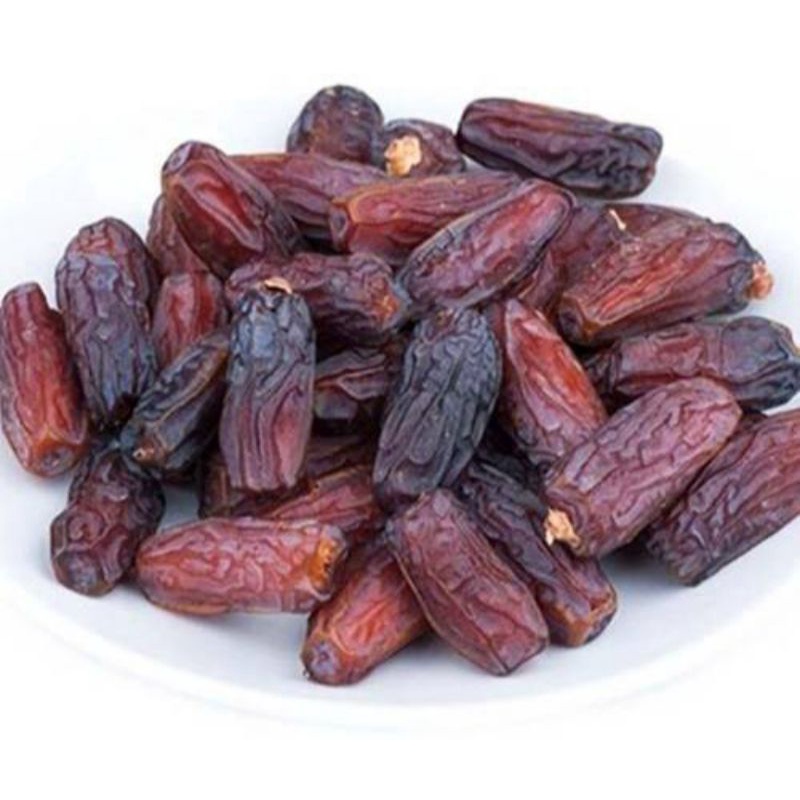
Most people in Malaysia meet Mabroom once a year, on a Ramadan table or a hantaran tray, and never think about where it was the other eleven months. This piece follows a Mabroom date through the Malaysian year: where it is grown, when new stock tends to land, when everyone wants it at once, and how a household or a small shop can plan around that. You can browse a range of Kurma Mabroom Malaysia stockists carry while you read.
Where Mabroom comes from
Mabroom is a Saudi date from the Madinah region. It is long and slender, reddish-brown, semi-dry and chewy. That last point matters more than it sounds, and we will come back to it.
Malaysia has no commercial date-growing trade, so every Mabroom sold here is imported. The box on the shelf should say so: the variety, Saudi Arabia as the country of origin, and the name of the importer or packer. If any of those three is missing, ask before you pay. How a date looks is not proof of what it is; the label is the record you can hold a seller to.
The season, roughly
Gulf and Middle-East dates are mostly harvested from late summer into autumn, roughly August to November. New-season stock then needs packing, shipping and clearing, so it reaches Malaysia some weeks after that. We are not going to give you an exact month for Mabroom. Nobody can promise one without the shipping records, and anyone who quotes a precise arrival date from memory is guessing.
Because Mabroom is semi-dry, it holds up well between harvests. You will find it outside the new-season window too, which is normal for this kind of date and not a sign that something is wrong with the stock.
When demand piles up
The Malaysian calendar has a few clear peaks:
- the weeks before Ramadan and the month itself, the biggest by far
- Hari Raya open houses, when dates go on the plate next to kuih raya
- wedding season, for hantaran trays and door gifts
- kenduri and tahlil, where a host may need several kilos at short notice
- umrah returns, when pilgrims hand out small packs to family and neighbours
Ramadan moves the calendar by about eleven days each year, so the rush shifts with it.
Planning around the rush
If you know you need Mabroom for a specific event, order early. That is plain logistics, not a sales line. In the weeks before Ramadan the same stock is being pulled by every buyer in the country at once, and the variety you want can sell through.
A few habits help:
- Write down the net weight you need and the date you need it by, then ask the supplier if they can hold that quantity from one batch.
- Ask for a photo of the current batch. Colour and size can differ from one shipment to the next.
- Compare offers per kilo, delivery included, not per box. Box sizes are not standard.
- Treat grade names (A, AA, Jumbo and so on) as that importer's own size sort. They are not an international scale, so a "Jumbo" from one seller may not match another's.
Keeping stock between events
The semi-dry texture is the reason Mabroom suits forward planning. Unlike a soft, high-moisture date that has to live in the fridge, an unopened box of Mabroom sits happily in a cool, dry cupboard away from direct sun. Once opened, move it to an airtight container so it does not pick up humidity or ants. If you buy a carton in one go and split it for several events, split it on the day it arrives and label each tub with the date you opened it.
Buying without the queue
For most households the easiest way to dodge the Ramadan crowd is to order ahead online and have it delivered. We wrote about that in more detail in buying fresh dates online in Malaysia. If you are buying for a kenduri or a shop and want to talk quantities, the Pengedar Kurma contact page is the place to start, and the Pengedar Kurma home page lists the other varieties we cover.
Mabroom will not be the flashiest date on the table. It is the one that is still in good shape in the third week of Ramadan, which is a decent reason to plan for it.