
The phrase "magic pills for fat loss" assumes there is a pill out there waiting to be found. Before asking whether any of them work, it helps to know what people are actually swallowing. A 2026 analysis of a large US health survey looked at exactly that, and the answer is a lot more ordinary than the adverts suggest.
Who takes weight-loss supplements
Liu and colleagues, led from Ohio State University, went through the US National Health and Nutrition Examination Survey (NHANES) from 2007 to 2020 (PubMed 41949480). Of 27,116 adults with obesity in the survey, 1,706 said they used dietary supplements for weight loss. Weighted to the population, that is 5.9%.
Use was less common with age. Compared with adults aged 20 to 39, the odds were lower at 40 to 59 and much lower at 60 and over. Women had higher odds of use than men. Among the people using them, 81% said they did so without medical advice.
What was in the bottle
The products were not exotic. The paper’s breakdown by type covers the 544 users who had logged their supplements over the previous 30 days. Among the supplement types they reported, multivitamin-mineral products were the most common, at 28.8%. Botanical products came second at 20.0%, and single vitamins third at 15.2%. The authors end by calling for counselling about the limited efficacy and potential safety concerns of these products.
So in that survey, the type of product reported most often for weight loss was an ordinary multivitamin-mineral.
One mineral, tested properly
Calcium is a good example of what a careful test looks like. A 2024 Cochrane review (Cormick and colleagues, PubMed 38721870) found 18 randomised studies with 1,873 participants, at doses from 0.162 g to 1.5 g of calcium a day. Most were done in the USA and Iran, lasted under six months and included only women. The reviewers found no studies of calcium-fortified foods.
The result on body weight was a difference of −0.15 kg, with a confidence interval from −0.55 to 0.24 kg, on low-certainty evidence. In the authors' words, calcium may result in little to no difference in body weight. Body mass index came down by 0.18 kg/m² and waist size by 0.51 cm, both on moderate-certainty evidence. That is a fraction of a kilo and about half a centimetre.
A herbal example
Botanicals were the second-largest group in the survey. Caralluma fimbriata, a plant extract studied as an appetite suppressant, was reviewed in 2021 by Jayawardena and colleagues at the University of Colombo (PubMed 34758791). Seven studies met their criteria. Against placebo, the extract cut waist size by 1.59 cm, but it showed no significant effect on body weight, BMI or hip size, and appetite measures did not change. The side effects reported most often were constipation, diarrhoea, nausea and rashes. The authors conclude that it is unlikely to be recommended as a weight-loss supplement or an appetite suppressant.
Prescribed medicines are a separate matter
Weight-loss medicines on prescription come up in the same conversations. The NHS weight-loss page says they are getting a lot of attention, but on the NHS they are only suitable for some people. It also says to only take weight loss medicine if it has been prescribed for you, because these medicines can cause serious side effects.
Where dates fit, and where they don't
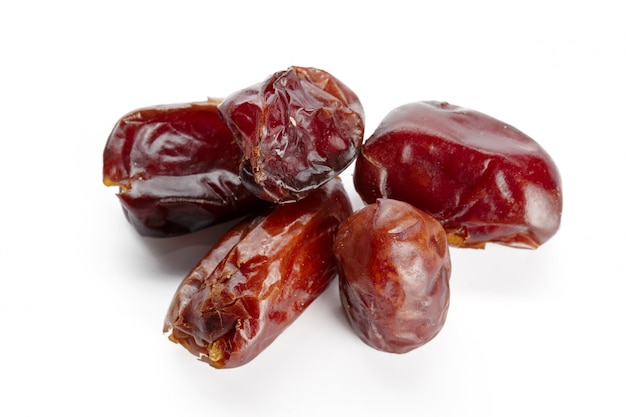
Dates are not a pill either, and nothing above says they burn fat. What they do have is published nutrient figures. USDA FoodData Central lists 100g of Deglet Noor dates (FDC 171726) at 282 kcal and 8.0g of fibre. A 30g portion comes to about 85 kcal and 2.4g of fibre.
The NHS says adults should get 30g of fibre a day, while most eat about 20g, and it counts a food as high-fibre at 6g or more per 100g. Deglet Noor clears that line. The NHS also names dates, with currants, sultanas and figs, as dried fruit where a 30g portion counts as 1 of your 5 A Day, eaten at mealtimes rather than as a snack between meals to reduce the impact on teeth. Those 85 kcal still count towards the day's energy.
Next to a supplement whose effect on weight in a Cochrane review was −0.15 kg, with a range that crossed zero, that is a modest claim. It is at least one you can check in FoodData Central.
About Pengedar Kurma Malaysia
The about page says the site handles everything from retail purchases to wholesale supply (runcit hinggalah bekalan borong), with orders sent safely across the country. Enquiries, quotes and orders go through WhatsApp, and the number is on the contact page. More date articles are on the blog. A link kept from the earlier version of this post points to Pembekal Kurma Selangor.
This article is general information, not personal advice. If you have a health condition or take regular medication, speak to your doctor before starting a supplement or changing your diet.