
This post's title promises easy weight loss from a raw diet, and the older version of it asked a fair question along the way: which fruits help you shed the most weight? The older post's raw menu leaned on fruit, vegetables and nuts, so the answer matters. One large study tried to answer it fruit by fruit, and its results come with clear limits.
A study that tracked people for up to 24 years
Bertoia and colleagues at the Harvard T. H. Chan School of Public Health published the analysis in PLoS Medicine in 2015 (PubMed 26394033). They used three prospective cohorts covering 133,468 men and women in the United States, followed from 1986 to 2010.
The method was simple to describe. Over each four-year stretch, the researchers compared how much a person's intake of a given fruit or vegetable changed with how much their weight changed. They adjusted for changes in other parts of the diet, smoking and physical activity at the same time.
Which fruits came out ahead
Each extra daily serving of fruit went with a four-year weight change 0.53 lb (about 0.24kg) lower. For berries the figure was 1.11 lb (about 0.5kg), and for apples or pears 1.24 lb (about 0.56kg), per extra daily serving. In the full paper, the individual fruits linked with lower weight change include blueberries, prunes, strawberries, raisins or grapes, and grapefruit.
Not everything on a plant-based plate pointed the same way. More starchy vegetables, including corn, peas and potatoes, went with weight gain. Vegetables that were both higher in fibre and lower in glycemic load were more strongly linked with lower weight change than lower-fibre, higher-glycemic-load ones.
These are small amounts, each spread over a four-year period.
What the study cannot tell you
This was an observational study, not a trial. The authors write that, even after measuring key confounders, residual confounding cannot be ruled out, and that any method of assessing diet will have measurement error. They also note that nearly all the participants were well-educated white adults, so the findings may not apply to everyone. The study shows a link between eating more of certain fruits and gaining less weight. It does not prove that the fruit caused it.
Where dates sit
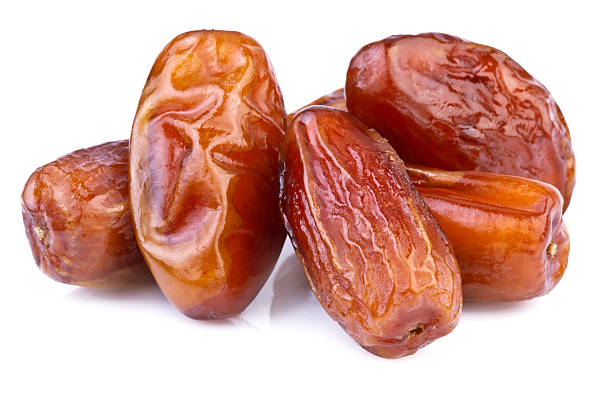
Dates were not on the study's fruit list, so it says nothing about them directly. The closest items it did include are two dried fruits, prunes and raisins. USDA FoodData Central gives these figures per 100g:
- Medjool dates: 277 kcal and 6.7g of fibre
- prunes: 240 kcal and 7.1g of fibre
- dark seedless raisins: 299 kcal and 4.5g of fibre
On those two measures Medjool sits between the two dried fruits that the study tracked. That is a comparison of nutrient tables, not evidence that dates affect weight.
The NHS counts a 30g portion of dried fruit, and it names dates, as 1 of your 5 A Day. It adds that dried fruit should be eaten at mealtimes, not as a snack between meals, to reduce the impact on teeth.

Whole fruit, not juice
The older post suggested drinking a glass of freshly squeezed vegetable juice. The Harvard team counted fruit without juice, and the paper's discussion uses the example of swapping orange juice (84 calories a serving) for apples (74 calories a serving). The NHS asks you to limit fruit juice, vegetable juice and smoothies to a combined total of 150ml a day, because crushing fruit and vegetables releases the sugars they contain.
The older post also mentioned nuts as a savoury snack and sent readers elsewhere to find more information. For anyone on a raw plan, the study points toward berries and apples rather than starchy vegetables, as a link and not a proof. Dates, which it never measured, fit the NHS advice best as a 30g portion eaten with a meal.
Buying dates in Malaysia
Pengedar Kurma Malaysia's about us page covers retail through to wholesale supply and delivery across the country, and it takes questions, quotes and orders on WhatsApp. The contact form is unavailable for now, so the contact us page gives the WhatsApp number. Other articles are on the blog.
This article is general information, not personal advice. If you plan a big change to the way you eat, speak to your GP or a dietitian first.